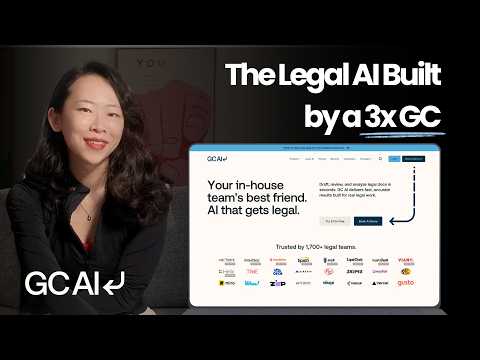
When lawyers get excited about Claude, Cecilia Ziniti sees lead generation for legal AI rather than a threat to her business.
Cecilia is the founder and CEO of GC AI, a platform built around the work of in-house legal practitioners. She joins Anna to discuss GC AI's focus, how legal teams should evaluate AI products, and how buyers can read vendor benchmarks without becoming either too cynical or too trusting.
In this video
Why GC AI remains focused on company legal teams, even when law firms offer another source of revenue
The three checks Cecilia recommends when buying legal AI: use the tools, assess answer quality, and build team-wide support
How buyers can interpret vendor benchmarks when every vendor appears to rank itself first
Why foundation-model adoption may expand rather than erase the market for purpose-built legal AI
00:00So, what is the one thing that you have chosen not to do with GCAI despite having the capital now to do it? Speaker change: We've been fiercely focused on selling to lawyers and companies, and we have said no on selling to large law firms. We have the money, we could do it. It's just I don't want the product to be designed for lawyers who sell their legal services. I want it to be designed for helping the company achieve its goals. Speaker change: What if um Anthropic does ship a legal reasoning model tomorrow? Do you think GCAI will survive? Speaker change: Yeah, I mean, look, like they're formidable at
00:32Speaker change: What do you think legal work will look like in 2045? Speaker change: Legal work will largely be done by agents. Speaker change: And will redlining continue to exist? Speaker change: It's a little bit of a relic, right? Speaker change: Today, I'm joined by Cecilia Zenaaty, founder and CEO of GCAI, a three-time general counsel that has lived the exact pain points the product is trying to solve. Cecilia has built GCAI specifically for in-house legal teams, and what I find especially interesting about Cecilia is that she is at the intersection of being a lawyer, a
01:02teacher, and a founder at the same time. So, today we'll talk about what it takes to build AI for legal teams, where GCAI fits in in a very crowded market, and what she thinks the future of legal work will look like. So, let's dive in. Welcome, Cecilia. Speaker change: Thanks, Anna, for having me on. Excited to be here. Speaker change: Yeah, so it's been about 6 months since you closed your 60 million series B, a whopping, very impressive 555 million valuation. Congrats. The last time that we spoke, you mentioned that GCAI is now
01:32serving 1,800 legal teams, which is really insane growth. And my first question to you is, what's different about GCAI today that it wouldn't have been possible 6 months ago? Speaker change: Yeah, so we have deepened our focus on the things that companies and their lawyers need. So, we've launched an API, so you can access GCAI in native spaces, like within your CLM, or within whatever workflows you want to create. We have deepened our solutions offerings. So, we
02:03have with the 1,700 customers, we have a critical mass across a lot of industries, right? So, we see a lot of retailers, financial services, tech, and there's a constant craving for making a product more and better for those areas. So, launched a bunch of things there. I would say the third thing is we've just made the product better. So, you reference our benchmark study, we basically have come out and found that we end up being about 5 to 10% more accurate than the foundation models. And that core work, we've launched an R&D group led by my former boss actually at Amazon. And we've got, you know, very
02:34experienced attorneys working on the core quality. So, I would say those are the biggest uh differences, but also fun stuff. We're up to over 100 teammates now and, you know, reached many more legal teams than last we spoke. So, very excited about the progress. Speaker change: And I would love to touch on the benchmarks in a little bit, but before we get there, a lot of people might assume that more funding doesn't necessarily mean more freedom with what you want to do, what you want to build. And I imagine you would now have a lot of pressure to scale, to expand, to also look bigger and also be faster. So, what
03:06is the one thing that you have chosen not to do with GCAI despite having the capital now to do it? Speaker change: We've been fiercely focused on selling to lawyers and companies and we have said no on selling to large law firms. So, even though, a little story, we've got someone from one of the big, maybe a mid-size firm, let's say 150 lawyers, and he pays for GCAI kind of on the side cuz he likes it so much. And he said, you know, can you sell to my mid-size law firm? And I said, you know what? No.
03:36Even though it would be good revenue, we've decided to make roadmap razor focused on the needs of companies. So, we're much more focused on integrations with others in the business, right? So, I did a poll on my LinkedIn and I asked, as in-house counsel, with whom do you collaborate more? Is it legal? Is it with others in the business? Or is it with outside lawyers? And something like 85% of the folks said that it was with others in the business, as in-house lawyers. And that's reflective of my own experience. But basically, having a North Star around that has exactly, as
04:07you said, allowed us to focus. Because I mean, we have the money, we could do it. Um it's just I don't want the product to be uh designed for lawyers who sell their legal services. I want it to be designed for helping the company achieve its goals. Speaker change: And taking one step back, you were three-time GC, and now you're also the founder. What was the shift that happened when you switched from the hat that you used to wear as guardian of risk for the different companies that you served to now being a founder? Do you think you are more aggressive now in
04:38terms of, you know, accepting risk? Or like, what was that mentality shift that you went through? Speaker change: Yeah, so I think the shift from general counsel or to founder is very similar to the shift from being a law firm lawyer to being in-house, where you know, you're shifting from identifying the risk to unlocking the possibilities. And I think I was a particularly effective GC in part because I had that mindset of like, we are going to launch this product. I always counsel my junior lawyers of like, you cannot have the
05:08mentality of like, can you believe the crazy business they want to do whatever it is in that they mentality. It has to be like, okay, we're all on the same team here. We have a legal skill set um within legal that we can use to unlock regulated areas or to launch quicker or to, you know, protect the company from downside in the form of advising on HR, all these things. So, the shift to CEO has been kind of that amplified. Now, I still want great lawyers. In fact, I think I would say I appreciate the general counsel role even more now that
05:39I'm a CEO than I even did when I was in it. But I certainly have, you know, a lot of empathy on the CEO side. You seeing possibilities and making them real is the job. Speaker change: And when you were a general counsel and I heard in one of your podcasts how you you talked about the story of when you first saw chat GPT come out and you used it and you were like, "Wow, this is going to change the way our profession is going to work. I want to be a part of it." Take me from that moment on to how you started GCAI and how you met Bardia,
06:10who is your other co-founder for the business. Speaker change: Yeah, so Bardia and I worked together at Replit, uh, which is of course a vibe coding platform. At the time the term vibe coding hadn't even been established, but the idea that, you know, by bringing, you know, great elements of a platform plus AI, you could essentially democratize software is very similar to what we're seeing now with law, right? So, that idea really captured me of like prior iterations of legal tech, you know, CLMs or matter
06:40management or signature platforms, all fabulous products. I love me some Docusign, but the actual work of a lawyer. You know, on a good month I would maybe log into Ironclad twice in that month or maybe three times, but AI is something that can be really, if you think of the initial co-pilot iterations, similar to, you know, software folks using Replit, you know, it's all day. It's the work. It's allowing you to create legal advice, to analyze documents, to be a part of, to amplify your judgment, right? If you're
07:10like, "Hey, you know, I want to look at this deposition and I want to figure out, you know, what are the key bits that I need to home in on?" Or, you know, on the in-house side, you know, we're considering launching a product, how do I go over XYZ risks? Like, the I was so taken with that that, you know, this is where it gets philosophical, startups really are applied philosophy. You have a philosophy, you have a vision, and then day after day, week after week, you put it into place. So, I can I can give you some of the details. There's definitely key moments in the company when we launched our beta, when we had our first One of the strongest
07:41early signs of product market fit was the website. We had a provider, one of our back-end providers, who went down for about an hour, and we had users being like, "I've forgotten how to practice law without GCAI." And just like it was almost like a like they were upset that they didn't have our service. And so, lots of different milestones like that, I would say that they kind of punctuate that journey. Speaker change: Yeah, that's amazing. So, did you in the beginning when you had this idea to say, "I want to build in this space and change how lawyers work and make
08:11lawyers" At that point, did you think that it was going to be such a important product that is almost like life support for some of the users that you're talking about now? Did you like, I don't know, share this idea on a company message group to say, "Hey, who's interested?" Or is it the other way around where Bardia was like, "Hey, like Cecilia, you should be building a company. I have I know how to like be an engineer, you you have, you know, everything else. Let's come together to do this." Like, how did it happen? Speaker change: Yeah, so it ended up that Amjad Masad, who was the CEO of Replit, who was my
08:41boss, deeply respect, he comes like, "Hey Cecilia, like your a good general counsel and all, but like is your head in it?" And I said about that, and we basically worked out that I should find a replace a successor, who I did. I did that. My last day at Replit was November 1st of '23, incorporated the company a week later. But I had been speaking with Bardia um separately. He had also left Replit to build his own thing, and he and I had worked together, had a reporting relationship as well as he was running had incubated multiple functions
09:11at Replit. And so, someone who can incubate functions and be a good product engineer, was just a a perfect match as a co-founder. I'm obviously deeply familiar with the ICP, had, you know, the vision, and had really a network, right? So, one thing I think people underestimate from having been a lawyer so long, lawyers naturally form communities, right? So, we took the bar exam together, we were in law school, we were at a handful of law firms, I of course was at Morrison & Foerster, and you know, I I was a fellow at the Ninth Circuit, so had a strong network of folks who I would want to work with. And
09:42I started off just teaching classes. I had WGCN, the Women's General Counsel Network, and actually started off teaching classes on ChatGPT as part of our discovery for GCAI. ChatGPT is a great product, and it was great then, obviously incredibly innovative, but it's not really made for lawyers. So, when I started teaching these classes, I saw, "Okay, lawyers need more precision. Lawyers need the ability to check citations because that's part of our ethical duties. Lawyers need a certain tone. Lawyers need the ability to add files because while AI and LLMs are
10:14excellent at word manipulation, you have to really kind of wrangle them to get what you need. And teaching classes and being exposed to customers, I you know, it's a unique go-to-market, but it was definitely part of the founding story of GCAI, and really driven by customer obsession of like, "Wow, how can I make this better every day?" Speaker change: Yeah, and I was one of those um students in your classes from the very early days. So, I definitely benefited from them. And um I heard in your podcast as well on your own CZ and Friends, you mentioned that both your mother and
10:45grandmother were teachers, right? Speaker change: Yes, so actually my great-grandmother as well, it turns out. So, I'm Italian, and you know, of course in Italy there's a strong, you know, education history, Montessori and and Reggio Emilia and the like. And as a child, it's like I I always gravitated toward that, but you know, I'll be honest, my dad's an entrepreneur, and he's like, "You can't make money teaching." Well, it turns out a lot of what you do as a founder is kind of teaching. You're influencing for sure. So, it's been a an incredible, I think, homage to my history to be able to do that.
11:15Speaker change: Yeah, and well, I mean, that's just amazing. And before we dive into the product, I just want to find out how you balance everything together with building a business, with your podcast, with teaching, with everything else that you're doing, with, you know, managing a 100-person team, and then also take this to the moon. Like what does a day in the life of Casetext look like? Can you walk me through that? Like from the moment you wake up. Speaker change: Yeah. I mean I mean, you know, the thing is is like I think, you know, having a
11:45company is very similar to having kids where you think about it all the time. You're basically it it's your life as a founder. And I had intense jobs as an executive previously, but as a founder it's another level. But it it's kind of it's a very similar journey to having kids where it's all consuming but you can't imagine life without it. So in terms of the day I do work the six days a week generally. On the seventh day I I do take, you know, time off, but I'll try to listen to podcast, keep current, you know, see folks, etc. Um but in
12:17terms of the actual day I I try to have dinner with my family at least two or three nights a week, you know, including obviously on the the Saturday. But the actual like how do you prioritize the podcast is another vehicle for talking to customers. And I learned very early at Amazon that customer obsession wins. And I spent a lot of time with the company emphasizing that we do all hands every week and we kick off either with an actual customer joining our all hands every third week or on the off weeks we literally read a customer quote, a piece of feedback every single week. And that
12:48I would say orients the calendar. Now, you know, I'm also like obsessed with kind of high performance and I you know, there's like a I listen to Tim Ferriss podcast and everything of like ways to optimize sort of within that. And you know, that's something where that you know, that that those how to do that is well documented, but I would say that the difference in flavor for me is I try to maintain a calendar where I'm talking to customers at least half the time, half the week. Speaker change: Oh, wow. And I mean and I'm sure that bleeds and translates into the product and what you're building at GCI. So I'm
13:19curious there seems to me from my observation of the legal AI market three bets right now that in-house legal AI startups are making. There is the legal front door tools for business, and you see those like the Wordsmiths and the Flames uh try to build solution that serves business first, and enables lawyers to serve business. And then you have the second bucket, where it's lawyer productivity tools for legal teams. And then also the third, which is more focused on being a AI native CLM or
13:49system of record. Where do you think GCAI um is betting? In my From my observation, GCAI is definitely betting. And in 5 years time, which of these bets, these three bets, do you think will look very obvious in hindsight, and which do you think will turn out to be something more just like in the market moment? Speaker change: Yeah, so the productivity aspect of being a lawyer's co-pilot, we went to that first because but we did it in a unique GCAI way, which is to go after lawyers at companies in-house. And the reason for that is who's the best at
14:21providing legal advice to the companies? It's the people that work there, right? So, the analogy I draw is David Zapolsky, general counsel of Amazon, been there 25 years, one of the top 10 highest paid execs in the building, seen the company through really everything, right? Antitrust, global trade, pricing, you know, privacy considerations. And Amazon is actually in the news about legal issues relatively little considering it's a trillion-dollar company. So, thinking about how do we go from helping people and departments,
14:51like David Zapolsky's department at Amazon, to then institutionalizing that and providing advice to you know, people say rest of the business, but I think it's really like the business. Now, the legal front door aspect is great, but for me, like where LLMs really excel is the actual work. So, getting lawyers to tune it, lawyers to That was the just kind of the the how of I think we reach that vision. So, will AI do a lot of tasks in legal that either lawyers or non-lawyers do today throughout the business, negotiating commercial
15:21contracts, approving marketing copy. Yes, that will absolutely happen. But my view, because of privilege and because the ultimate judgment required is having the lawyers be your users first, and then creating these things where the lawyers can set up intake how they want it, the lawyers can set the negotiation thresholds, and have the company's success as their North Star, and them being our customers, to me, that was the way to do it. So, you know, CLMs are good, they have a time and a place. I think, you know, I would be more nervous
15:51if I was CEO of a pre-AI CLM company. Um I think some have adjusted, you know, better than others, and I think, you know, going AI native, but I also wouldn't underestimate the change management required um to do that. And so, part of what we've done at GCAI is, like I mentioned, our API. You know, we're going to plug into those. We have one prospect that told us they have nine CLMs because they've been very acquisitive. And so, they're like, "Hey, give us GCAI to go through those nine. We'll give you an API to all nine of them and help us with that." So, I think
16:21the legal subagent future that I envision is, you know, the the sort of way to get at it is how we've done. Now, it's a different way than others have done it. That's fine, but we've seen some good, you know, very good results commercially from the way that we've approached this market and this tech evolution. So, I'm very bullish. I'm also curious, which um of the other two bets would you be more bullish about? Like, if you were to expand GCAI's capabilities today, would you focus on the legal front door part of it, or do you would you want to build out your own
16:52CLM? Yeah, so both are sort of strategic priorities for GCAI, but we're not going to build CLM as it as it currently exists. Um so, the product capability, we're calling it Vaults, but essentially, it's the ability to go in different different doc stores, not just contracts, but different doc stores, and have the same high-precision, high-intelligence interface that we have now with a subset of documents. So, on the document side, that's one that I think will be very important. Now, that being said, contracts, you know, live in many places. I read an Economist article
17:23recently that made the case that all of private equity is a contract. You got to create the fund, you've got to get the funders, you've got to buy the thing, you've got to renegotiate the contract. So, there are a number of things, you know, SaaS companies, at GCAI, 9% of our revenue goes through one agreement, our MSA. So, I'm very bullish on contracts. On the legal front door, this is where I think the ability to interrupt with the kind of company's main agent, um, is super important, right? So, some companies are choosing Claude, but other companies have picked other things. I do
17:53think a company like an Acme is going to have like an Acme agent, and is going to want a legal sub-agent that interacts with that Acme agent, be it through MCP or API. I think that is still an open question, but we're preparing for that. Speaker change: So, then you you mentioned about understanding the ICP, and you also is very clear that you are building for in-house teams, but I just want to double-click into that because in-house teams is such a broad spectrum. You have like the solo GCs there with their
18:23they're wearing multiple hats, or maybe, um, they're yeah, they have to to figure out everything from the for the company. They have very little outside budget, so they probably have to do a lot of legal research as well. And then you have like the private equity in-house teams that's working on completely different things from what, you know, most other maybe enterprise in-house teams are working on, which is general commercial deals. So, who today is GCAI's real ICP within the in-house legal sector, and how has that answer changed throughout your time
18:53building GCAI? Speaker change: Yeah, so we started off with smaller teams, mostly because of the adoption curve, right? So, I something I show our team all the time, maybe we'll put in the show notes, but there's a book Crossing the Chasm that talks about how big technology shifts everything from mobile to cloud to all these things are adopted, right? And all the way to the left, the people who were using AI 3 years ago, those people are early adopters and they tend to be at smaller companies. So, even fractional GCs,
19:23they're sort of like the indie hackers of legal. I think you've got some in your community. Today, legal AI is unquestionably broadly adopted, right? So, we get people in our classes saying we've got, you know, I think something like 92% of the people that take our classes are using AI for legal work at least once a week. So, that has shifted and we at GCAI have met the moment around being able to serve that partly because of our very clear interface, our higher accuracy, all the things that any kind of lawyer wants. Those are attracted to a very broad swath of folks
19:54in-house. Also for us, when you said how it's shifted, we get feedback every single day on the UI of the product, on the answer quality, on what people want to see. And so, to your point, we've built that in and as we've brought in our spectrum, then able to meet different sectors. We are pretty industry agnostic, although we have natural clusters, right? So, we have retail as a cluster for us, you know, a couple of retailers that we have that I can tell you about, Vuori, Arc'teryx, Bass Pro Shops. We've got, um, Love's Travel Stops, which is the largest operator of convenience store, I'm
20:25sorry, truck stops in in America. And so, there are natural groupings, a lot of them. For example, if you're a retailer and you've got to open new locations, you're worried about permit issues, regulatory around that, employment law. And then, of course, we also naturally see a lot of ICP characteristics in software companies, right? Because what is an MSA? It's a commercial contract. You're selling software, but the MSA really governs what you're selling. So, there's a lot of legal work around that, to your point. And then, um, you know, but we also see a lot of financial services.
20:55So, companies where you have a lot of lawyers, a lot of people that need, you know, good AI to do what they do and, you know, come into this legal AI era. So, I would say, you know, that that being said, like the more the less I would say strapped a particular team is, if your legal team feels like you don't have too much work, I don't meet these people very often, but there are overstaffed legal teams, supposedly they exist. If you're overstaffed, you're probably not a great fit for a TCA. Um is the only thing I would say in terms of who's not ICP. But within
21:26companies, I mean, there are some, you know, I talked to a venture capital fund. We have a couple of venture capital lawyers on the platform. We're not even a couple, we have a good very solid number of VCs GCs on the platform, but more it's people who are sort of mini GCs for the portcos as well, as opposed to doing pure fund formation, which is a little bit more like law firm work. Since we're on the topic of how to evaluate um what is a good fit or not um for legal teams, if you were wearing the hat, the actual general counsel today on the buy side, how would you navigate
21:56between the different kinds of legal tech tools that's out there targeting different kinds use cases and obviously with a different kind of product focus, whether it be legal front door or a CLM-centric focus or you know, the Swiss Army knife that tries to cover everything, compared to the general purpose solutions out there like Anthropic, like ChatGPT, compared to just building something internally, given that it seems has never seemed easier to vibe code and build yourself. And is the question, you know, more nuanced than either this or that? Does
22:27it depend on what kind of legal team you're currently in? Can you walk me through that process of how you would navigate it if you were in the buyer's position today? Speaker change: Yeah, so kind of as a buyer, there's sort of three things I would do, just kind of like they're basically tool-agnostic things. One is try the actual tools. Like literally get in there and use them. Ride the actual bike and compare them. Now, Claude for legal, pretty good, but you know, I hear from people all the time, 6 hours of setup and I got nothing or it hallucinates so
22:58badly or do I really need to vibe code, whatever it is. I literally was GC of a vibe coding platform and I still would say that I would consider software. So, try the tools themselves, get in there and try it. Second, and assess the answer quality. So, that's something that like lawyers are really smart and you're used to paying more for better counsel, right? You can decide to use a solo for something, you can decide to use a big firm, you can decide to use a mid-size firm, you can find a specialist, you can find a generalist. You already know how to evaluate legal
23:28output. So, apply that same rubric to your legal AI and your legal AI answer. Do you But, whatever it is, I would say So, so a couple things. So, try the products, assess the answer quality, and get your people doing that. The third thing I would say is get buy-in across your team. So, where I have seen AI initiatives not go as well is this sort of like from on high being like, "Thou shalt use AI." And it doesn't work as well as like more either collaborative methods or like people talk about
23:58hackathons. We just did one, we did a hack week the whole company because not only lawyers, right, should be working with AI, everyone should be. And so, we did that, it was very successful. Replit now has that where they'll come in for a couple of days and run a hackathon for your company. So, see, that's my my high-level advice. We can get into like the differences between the platforms. Personally, I've been using Claude code. I did have the situation where it randomly emailed someone, you know, the the which is just I can't have that for my core legal tool right now. And maybe it gets fixed, but between that and the
24:29privacy and privilege issues for me as a GC, I would not have exclusively relied on that my legal tooling. I just it's not there yet. Maybe it'll get there, and I saw the, you know, the conversation that Anthropic had on Friday, but I would say from a maturity standpoint, it's about a year and a half behind where we are on GC AI in terms of the tooling and certainly on security and kind of amount of control that you that you have. Speaker change: So, what if Anthropic does ship a legal reasoning model tomorrow on top of all of the legal plugins and the connectors that they're building, they're also
24:59collaborating with lawyers and with communities to improve their product and build in legal specific functionalities. Do you think GCAI will survive all of that if they ship tomorrow and make all of that happen? Speaker change: Yeah, I mean, look, like they're formidable. I don't I don't believe that they're not. It's more just a question of, you know, the ability to build my own car. I have that ability right now, but when was the last time you change your own oil? Never. That is not a thing, right? You go to Jiffy Lube or
25:29whatever it is and you get your oil changed. And so, you know, build or buy, I I can't think of any company, you know, that's going to build their own version of Microsoft Word. Like that's crazy. And so, on the like needs for yourself, I come back to enabling the lawyers. And then for us, we've invested a whole lot of R&D into what we've done. And you know, that that said, like I think Claude will be perfectly acceptable if you're comfortable with a slightly inferior answers and you're comfortable with the headache of building yourself, right? So, for us,
25:59when you want to do a Claude plugin, yeah, they launched 35 of them, but okay, which one are you going to use in a particular scenario? And does it know your company? And, you know, we work with companies with a lot of interesting unusual businesses that are marketplace company for fintech. Do they pick the commercial one? Do they pick the financial one? What if they're a litigator at that marketplace company for fintech? So, it's basically the amount of kind of headache. And I mean, look, I think they'll be good, but I think they necessarily won't be able to raise their focus on this persona the way that uh that we have at GCAI. And also, I find I agree with um, you know,
26:30the Max at Legora and and Winston at Harvey that when people get all excited about Claude, it it's lead gen for us because people try it, don't have a great experience, and then come to us. Speaker change: And speaking the buyers and their evaluation criteria, what do you think are some of the proxy metrics that you see um legal teams use to select tools? And what do you think like really bad proxies that you would love to like, you know, if this was an educational moment to share with other legal teams are struggling with, you know, all of these
27:01options out there apart from you mentioned something like trialing the tools. What do you think are good metrics and what are bad metrics to reference? Speaker change: Yeah, so good metrics is I'm going to lean on usage right now. AI is still in this phase dependent on your lawyers and your your legal folks using it or your business folks using it, right? We have 30% of our seats are actually non-lawyer seats, right? Procurement, finance, HR, etc. But usage to me, I always use the metaphor internally of like the
27:31restaurant at GC of GCAI. And when you're deciding what meal to have, you know, can you like grow your own tomatoes and all that? Of course, and you should. But if you want to not have to deal with that, then like that's the difference. But in terms of metrics, let's see. So, NPS is net promoter score. How likely are you to recommend this to a friend? We watch that very fiercely. Our NPS is 77, which basically is higher than the iPhone and Amazon. And it reflects that we are fiercely focused on the entire experience being
28:02great. I would literally set up a poll. So, we've got one of our our companies that we recently launched with a a big bank in Canada. Essentially polled their people. They had, you know, 100 people and they polled them all and said, "Hey, you know, how are you liking using the tool um midway?" And similarly, we had another customer public that we work with them at Zscaler and they've said publicly that, you know, their trial ended and people didn't have access and we're like, "Give it back. Give it back." And so, this kind of like happiness metrics I would say are good
28:33metrics. So, the way that you can express that is daily average daily average users over monthly average users, meaning of the people who log in a month, how many log in every day. Our number is like very high. I think it's like 56% or no, it's 56 about Anyway, it's high. I don't know it offhand, but anyway, high. Metrics that are less good metrics, I would say you kind of have to Another good metric is around outside counsel displaced, and you can calculate this yourself. So, I think it's very hard for us at GCAI to say how much this saves, but we've encouraged our users
29:05during their pilot and beyond keep an eye on outside counsel spend and look at what changed, right? So, if you adopted GCAI and your outside counsel spend was $100,000 in month one before you did, and it was $50,000 in month two, you know, you can attribute at least a portion of that $50,000 save to the tool. So, I would say knowing your outside spend, watching it as compared to usage is another great metric. Metrics that are not great are kind of like, I don't know, taking an hourly billing rate of your outside counsel and
29:35and necess- just using that. Also, of course, it's controversial, not my area, but people talk about saving outside counsel billing them less, but I don't think that's been happening um in terms of versus not calling them. Yeah, exactly. That's not been happening. So, I would say I'm skeptical of that metric when I hear it from the law firms. Speaker change: And what about for folks at the beginning of this journey when they are just surveying the landscape and have a thousand different options to choose from? Like, what are some, you know, good and bad proxies for them to pick which tools they want to shortlist and
30:05give a try? Speaker change: I mean, I personally am not a huge fan of ads at baseball stadiums. I mean, I think they're helpful for awareness, but if you're serious and putting the pedal to the metal around what my team's going to use, I think your legal community is going to be a stronger proxy for what you might like. Ask a friend. So, we did a we sponsored the National Retail Federation's Legal Summit, and we're particularly good for fit for retail, which I mentioned, and 40 people requested demos thereafter because it was like, "Okay, what are my peers using
30:35and what do they like? And what is the sentiment around that tool?" The other thing I would say is, you know, I didn't mention this, but just get yourself educated and be a good corporate citizen, right? So, if your company's like, all right, we're all in on Claude. Okay, you know, you don't have to fight that, but think about, okay, what tools are going to work well with Claude? What does my team like about Claude? What can they do in there that they cannot do in a legal AI tool? And then isolate those use cases. I also, this is more tactical advice, I personally would not commit to a CLM in in 2026. I wouldn't do it. I
31:05would consider a DocuSign or I would, you know, have a short-term commitment to a CLM, but a CLM that takes 9 months or a year to implement and has a 50% failure rate, I wouldn't do that this year. Speaker change: A lot of the CLM startups I've spoken to say it's the time frame is dramatically shorter now to onboard and integrate, some as short as 1 month to get everything running. So, are you are you seeing otherwise? Is does it actually take way longer than what they're saying? And what are the reasons for why you wouldn't suggest a legal team to commit to a CLM now?
31:35Speaker change: Yeah, so I this is not an area I'm an expert in in terms of implementation of of legacy CLMs, but I the fact that a lot of the CLM providers actually advise you have an outside consultant to implement them to me is a little bit of a red flag because if it was that easy and it was that quick, why am I going to have to spend 25K on top of the 200K or 300K or whatever it is I'm spending on your platform. So, we don't do that at J CAI, you can implement it with us and it's part of the at least for the core AI activities, it's part of what you get
32:06when you work with us. So, I'd say that's a flag. I would say for kind of the the shorter time for the new age CLMs, that's great. Good. I'm delighted to see it. I would expect it, but I also am like, I think the use cases and the technology is evolving so fast, I would want to make sure that whoever I committed to was committed to you asked earlier in the pod about speed of shipping. So, J CAI, we've launched dozens and dozens of new things in the time we've been here, constantly raising the bar. In part cuz we got to be better than the foundation tools, right? So, we're constantly adding more things, and
32:38we've had customers, you know, ask for features, and then we we ship them that day. So, um I would say part of you're assessing partly the culture of the vendor that you're going with. Speaker change: What's a recent example of something that was asked for in a day and shipped in that day? Speaker change: Yeah, so how we do our projects, how you add files, basically someone was like, "I want to be able to fork it in a particular way." And they asked in our user slack, and then we did it. I mean, this was kind of a UI change, so it's a little bit of an extensive, but
33:08another good example was we do have fractional GCs who do bill by the hour. They asked us for timestamps. We shipped timestamps. Company profiles, we have some Somebody wanted to alphabetize them. We alphabetized them now. So, little stuff like that. On the alphabetizing, it might not be shipped yet. I think it was literally happened like last week, so I don't want to talk out of turn, so I need to check. But, that would be another another example, but I It's funny cuz lawyers who are listening to this, hopefully by the time this pod airs, we we will have launched it, but lawyers who are who listen, they love that kind of detail, and the fact that we are so earnest about that kind
33:38of stuff. I never ever want to talk out of turn. I want to make sure that, you know, it's What is it? A claim substantiation, right? So, I want to make sure that that I'm doing the doing the right thing. Speaker change: Well, that was properly calibrated. Yeah, so speaking about benchmarks, cuz you talked about how important answer quality is to GCAI, and also about how legal teams should assess answer quality before they commit to a tool. You recently published a benchmark where GCAI beat ChatGPT, Claude, Gemini, and answer quality for wide range of in-house legal tasks. My question to you
34:09is, and I know that a lot of people might think this, which is if GCAI had scored worse than Gemini or any of the other general purpose tools, would you have published it? Speaker change: Yeah, I mean, we published a bunch of tasks, and there are some where GCAI is not the top performer. So, so we can take a look at those, and we will publish of our sample tasks, we'll publish a couple of examples for those. That being said, we assessed fitness for a GC, fitness for in-house. And we had R&D attorneys from Amazon and Nordstrom
34:39and Pinterest, all of whom, you know, have done this job as part of the evaluators and came out with our criteria. So, it's not surprising that an AI called GC AI would look at the best fit for GCs, but that was what we tested and we were super honest about that. Would we have not published if it was worse? You know, yeah, look, I'm pushing the team on quality all the time. And we've been assessing quality not calling it a benchmark report, but we've been assessing quality since our earliest days of existence when I was figuring out if I could even charge for this. So, remember the history, I was teaching those classes, which I think
35:10you and others took, but, you know, I I actually had a revenue coach at the time and he said, "Cecilia, people are using your app, you know, hundreds of times a week. You need to charge for that. It's better. I don't care if you think it's not better for XYZ use case, you're charging for this." And so, that's been something we've calibrated since the beginning. But yeah, I mean, like we want the state of the art to improve. When AI models are better, it's better for everyone. We did have the surprising finding that GPT outperformed Claude um on a variety of use cases, which I think there is a a sense that Claude has the
35:41best models for legal, certainly they've marketed that way, but, you know, that was a surprising result that we found that we were comfortable publishing. Notwithstanding that we, you know, we have agreements with Claude and we're, you know, in a very good relationship and so on. Speaker change: Yeah, right now, I feel like the entire industry is in competition with each other. Like you're cooperating at the same time competing with each other, which is uh really interesting. But, how do you think legal teams should read these vendor published benchmarks without either being too cynical or too trusting? And the reason I say this is that we all know, like GCI isn't the
36:11only one that published their own uh benchmark, right? I will publish theirs, Harvey published also theirs as well, and then I I see more coming down the line. And each vendor, I mean, not surprisingly, always ranked their tools first overall. So, how do you think um legal teams should have Yeah, I mean this is where I come back to what I said at the at the top of the call, which is try the product. Like your lawyers are smart. You know your use case. If a vendor doesn't allow you to try the product for a while, it was rumored that or not it was rumored, it was the case that some of the bigger or not some of
36:42the bigger or I don't want to name names, but there are vendors out Speaker change: Oh, you can name it. It's Harvey, right? Speaker change: So, they would not give you a free demo. Like they they would not be allowed to have a demo without talking to somebody. We've debated internally at GCAI that we have a self-serve where you can go to gc.ai/new. Anybody listening, go there. Create an account. To me, hiding that is a little bit of a red flag, right? And so like conversely, the green flag is you know what you're looking for, try it. I can publish benchmarks till I'm blue in the face, but to actually see it on
37:13workflows that you have, you know, we have people from logistics companies. We had one incredible one where she called me. The answer was so good, she called me. She had to basically they had a job site where there was some essentially dispute and she uploaded the relevant standard, the materials around the dispute, gave a little bit of background, and the letter that she wrote, she was like, "Oh my god, no changes." You know, three to four hours worth of work easily, maybe even a full day. And you know, another guy on the
37:44retail side, I show him essentially an alpha version of our vault where he's like needed to extract some information from leases. He's like, "I'll never get my weekend back." And this is like an incredible jaw-dropping thing. You know, I have empathy for GCs and things comparing the different tools. There's a lot of them, you know, but I would say in the case of redlining in particular, like see what your playbooks are, get in there and do a head-to-head. It's just my best advice. Speaker change: And speaking comparison, what are the scenarios that GCAI would win in pilots
38:14and when do you lose? Speaker change: Yeah, so we most often win when people try the product. So, when people try the product where a significant portion of the team is actually in GCAI, we win like 70 north of 70% of the time. Where we do not win is where we're not there for whatever reason, where either because we were not in the RFP or come in late or occasionally we've had where, you know, the security process is such that, you know, getting a new vendor is just not in the cards. And so we'll have
38:45a conversation, we'll meet the GC, they'll take our class, they'll love it, but for whatever reason, you know, sometimes IT or others will lock it down. Now, we're working on that, we have a leading trust center and security is very important to us, but sometimes, you know, equipping the GC to make that case that, you know, better tools for legal are best really make a difference for the whole company, that's a strategic thing that we're looking at, you know, just more generally today. Speaker change: Yeah, and you are hyper-focused right now into making the lawyers' life
39:15easier, more productive, have better high-quality outputs in the moment. But if you zoom out and look into the future, what do you think legal work will look like in 2041? Speaker change: 2041, wow. All right, love that. So I think legal work will largely, a lot of legal work will be done by agents, and you'll need a lawyer to help manage your agents. We do see GCs being empowered across multiple companies, and you know, similar to like, you know, how accounting software did not create fewer
39:47accountants, in fact, accounting software gave rise to strategic finance. Um I think we're going to see lawyering become more strategic, and I do think 2041 contracts are being negotiated by agents. I that's that that's an easy one, but the core of like, what are you selling? Is there a meeting of the minds, literally? That's what contract law is. I think that will need to continue, and who tunes those dials, whether it's a procurement person or a procurement person in concert with a GC who's like one GC for for company, or, you know, how that works. I I don't have
40:18the specifics on that, but I foresee that that it'll evolve. Redlining continue to exist? It's a little bit of a relic, right? It's a little bit of a relic, but I think ultimately, if you think about philosophically about the purpose a contract serves, you know, it's serving to memorialize that meeting of the minds. And so, you can either have the contract on the front end or you can have the litigation on the back end, right? So, to me, a a good lawyer or good contract negotiator in that case is figuring out what is the actual deal. So, our case we're working on a an acquisition now of a of a smaller
40:49company and as part of that, the work is not so much the LOI. Like, yes, the LOI should be accurate and good, but it's like, what should be in there? What are we buying? What are we committing to? Should we do the deal? Like, that's the strategy around it. And you know, the kind of like how the earn-outs work and stuff. There's some brilliant stuff to be done there, but I do think AI will significantly help and it'll be able to assess like, if you do this deal, how does this play out, right? Give me a whole bunch of scenarios in ways that I can that you can't now. And
41:19Speaker change: there's one very interesting study that I read. I mean, it's like a fun experiment from Anthropic, Project Deal. I don't know if you if you read about it. I don't know. What is it? Speaker change: Where they use agents to negotiate different items for sale within the Anthropic team and it was completely done, the deal from start to finish by agent. Speaker change: Yes, it was like their little eBay within within Anthropic. I did read about that. Interesting. Speaker change: Yeah, I thought that was interesting and that was just like one sign to me that perhaps in just a few years time redlining, which is something made for human eyes to look at, is no longer maybe going to be relevant.
41:50Speaker change: Yeah, I mean, look, I I think that we had someone, I think it was the it might have been Nat Friedman was saying that he had hooked up Open Claw and he basically had wired it to his Tesla and you know, in the in your iPhone when you look up something on Google Maps, it can send the location to the Tesla. TLDR, he basically the AI decided that he was not getting enough of a certain nutrient and it redirected his car to go to GNC like the supplement store. So, it was like
42:20when you I mean it's terrifying, but it's actually like when I think about it, I worked on autonomous vehicles at Cruise. I filed a patent on rerouting your autonomous vehicle based on sentiment and this is very similar. This is the AI deciding, "Hey, you look sick. Go get some you know, some vitamin C or whatever at at the store's emergency or whatever it is." So, you know, crazy. So, if you think about what what is the offline equivalent or what is the law equivalent? I think it's what you described of this marketplace. So, yeah, we're going there. I think, you know, a lot of I get the question a lot of like, "Okay, what does it mean to be a lawyer anymore?" Well, a lawyer asks the right
42:51questions. A lawyer does the right things. You know, we similarly have heard a situation of an M&A being scuttled because, you know, the asks from the founders, i.e. Claude, them using Claude, were so like weird. They asked for like damages or weird stuff and it just was like, "Do you really want to do this deal?" And you know, I think as a founder now, I don't want to mic code my own lawyer. Speaker change: Like I know that I need that and I know that I need, you know, AI to help me. But at the same time, we also know what something like Ethan what Ethan Mollick said, which is the AI you're using today is going to be the worst version of the AI you'll you're going to use. So, then
43:22it's like when you when you first saw ChatGPT come out, you know, in 2023, it was like, "Oh, it was like it's pretty bad. Like it can't do anything." And look at it today, it's doing a lot of things. So, do you think that in future as it gets better and we all I mean, it's almost sounds like a sound bite that oh, legal judgment is something that AI will never be able to replace because that's something that humans uniquely have. What if it could and it is already doing that at some degree throughout the execution of these different tasks that agents are doing? It's exercising judgment. It's steering the car to GNC to get vitamins for your
43:53friend. So, it in those scenarios, do you think any were completely candid what like whether there will be like realistic less lawyers needed in the future? And in the previous episodes, I've had founders have gone both ways up. So, regardless of which way, you're not going to be alone. Speaker change: Yeah, I mean, fewer lawyers, but more technologists. I also think there'll be more disputes, right? So, I hear from a lot of GCs saying their customer complaints have gone way up to have a legal flavor. Cuz anybody can write a letter to, you know, Amtrak or something
44:23saying that their thing was late and they want a legal refund, right? So, I think it will That being said, you know, the Economist article I referenced earlier makes a case in the US lawyers have a special power more so than in other countries. We may see some equalizing there. I think that's that's fair to say. I think the It's a great time to be in-house also partly because you have the business and the lawyer skills. So, if you only have lawyer skills, and if you only have written lawyer skills in particular, you know, text-based analysis, diligence, that
44:53kind of thing, but, you know, if you have a special skill like that you were an enforcement attorney at the Securities and Exchange Commission, you can be for darn sure it's very valuable to have you advising me if I ever have an SEC matter. So, I would say, you know, there may be a barbell effect of that like special experience and then, you know, kind of more lawyers at at the low like at the low end, but I think it's more going to be the situation like what I said with finance and Excel where the fact that we could do more will encourage Now, they're going to bring it
45:24more in-house. I think that will absolutely happen, but that's how I see the world evolving. Speaker change: And would you recommend your kids to go to law school today? Speaker change: I would, but only based on I would make sure they either knew AI or were using AI first. Speaker change: Okay. Few quick fire questions before I let you go cuz we're actually speaking on a Sunday. Appreciate your time so much. What does your tech stack look like today? What is the AI stack of Casetext running at the frontier of legal AI? Speaker change: So, I love Grainola. Um that is my meeting recorder choice. Um we do give
45:55warnings on that, but I love that. I love Slack. We are very Slack forward. So, we've got Slack connectors with Casetext AI, but also with Claude. Other big part of my tech stack, I do use Claude for uh scheduling tasks and things. We're building that in GCAI, but Claude has, you know, a few a few more. We're building, of course, the API for GCAI, so you can access it anywhere. I also am a heavy user of voice, and that's from having worked on Alexa. So I have a lot of Alexa devices. I'm disappointed Siri's not there yet, but uh Whisper Flow is the other voice tool
46:26that I highly recommend. It's basically just more accurate voice dictation. Speaker change: And who do you read or listen to cuz you mentioned that you listen to podcasts in your downtime? That's changed how you think about them. Speaker change: Of course, yeah. How I How I built this is a favorite. It's basically founders and entrepreneurs. And fun fact, the podcast episode with the founder of Sun Bum, the sunscreen, basically it helped inspire the name GCAI cuz he said you got to tell people what it is. And Sun Bum is like It's got sun in there. You kind of know. And it's also super
46:56well-designed brand, so we try to do the same. Speaker change: What's one legal AI take you believe strongly with that most people would disagree? Speaker change: Lawyers are the some of the best users of AI because they're really smart and great with words. Speaker change: All right. And the last one, what's something that most legal AI founders are dealing right now but not saying aloud? Speaker change: I think it's eustress, e u stress, where it's stress but it's good cuz it's motivating. Speaker change: Thank you so much to Jailal for our conversation. I enjoyed it so
47:27much. It was fun. Speaker change: Yeah, this was fun. Good questions. I loved it. Thanks so much for having me.